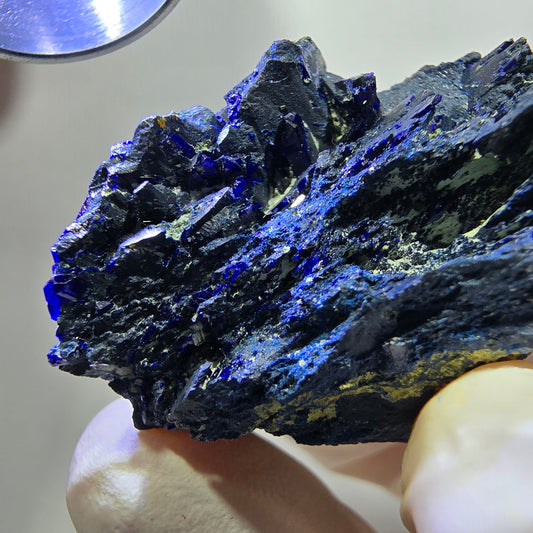
Welcome to the enchanting world of copper minerals! Today we would like to introduce you to a stone that, like few others, captivates with its electrifying depth of color : azurite. Its name derives from the Arabic word "lazaward," meaning "blue." This mineral was already prized as a valuable pigment in antiquity, but in its crystalline form from Namibia, azurite achieves an aesthetic perfection that makes it the centerpiece of any discerning mineral collection.
Namibia: Home of the world's best Azurite
While azurite occurs worldwide in copper deposits, Namibia enjoys a legendary reputation among collectors. The geological conditions in the oxidation zones there have produced crystals that are unsurpassed in terms of size, luster, and color saturation . Two regions in particular are of interest:
Tsumeb: This "Mecca of mineralogy" is world-famous for what are arguably the finest azurite crystals ever found. The specimens from Tsumeb are characterized by their often large, prismatic crystals and a deep, almost black "royal blue" color. When held up to the light, these crystals reveal a glowing azure blue of incredible brilliance.
Kaokoveld: This region is known for its aesthetically pleasing, often rosette-shaped or spherical aggregates . Fascinating combinations with green malachite are frequently found here. The azurites from the Kaokoveld often have a silky luster and a brighter, turquoise-like blue hue that harmonizes beautifully with other copper silicates such as shattuckite.
Scientific facts and properties
Chemically, azurite is a copper carbonate hydroxide with the formula Cu₃(CO₃)₂(OH)₂ . It crystallizes in the monoclinic system and often forms complex, sharp-edged crystals. With a Mohs hardness of 3.5 to 4, it is one of the softer minerals. This means that while it is robust enough for display, it should be handled with care to preserve its sharp crystal edges and vitreous luster.
Care and protection of your blue treasures
Azurite is a "living" mineral that reacts to its environment. Over geological timescales, it can transform into green malachite through water absorption (pseudomorphism). To permanently preserve its brilliant blue color , you should follow these tips:
-
Light protection: Keep your Azurite away from prolonged, direct sunlight. Too much UV light and heat can cause the deep blue to darken or become dull over time.
-
Cleaning: Never clean the stone with water or chemical cleaners. A soft, dry brush is the best tool for gently removing dust from between the crystals.
-
Storage: Since azurite is sensitive to acids (even the acidity of the skin can leave traces over time), a dry, protected place in a display case is ideal.
Whether as a historical pigment mineral or a high-quality collector's item – an azurite from Namibia is a piece of frozen sky . Its unique color and the fascinating crystal forms from Tsumeb and Kaokoveld make it an indispensable highlight for every mineral lover.
Discover the deep blue magic of azurite now and find your personal unique piece at Mineralodo!